You spent hours drafting your essay, starting with a pen and paper, carefully structuring your arguments, and finally typing the words into your computer. Yet, when you submit your work, your instructor sends an email stating that Turnitin flagged your essay as AI-generated. The anxiety is immediate, leaving you wondering how to prove you did not use ChatGPT when a computer program insists you did.
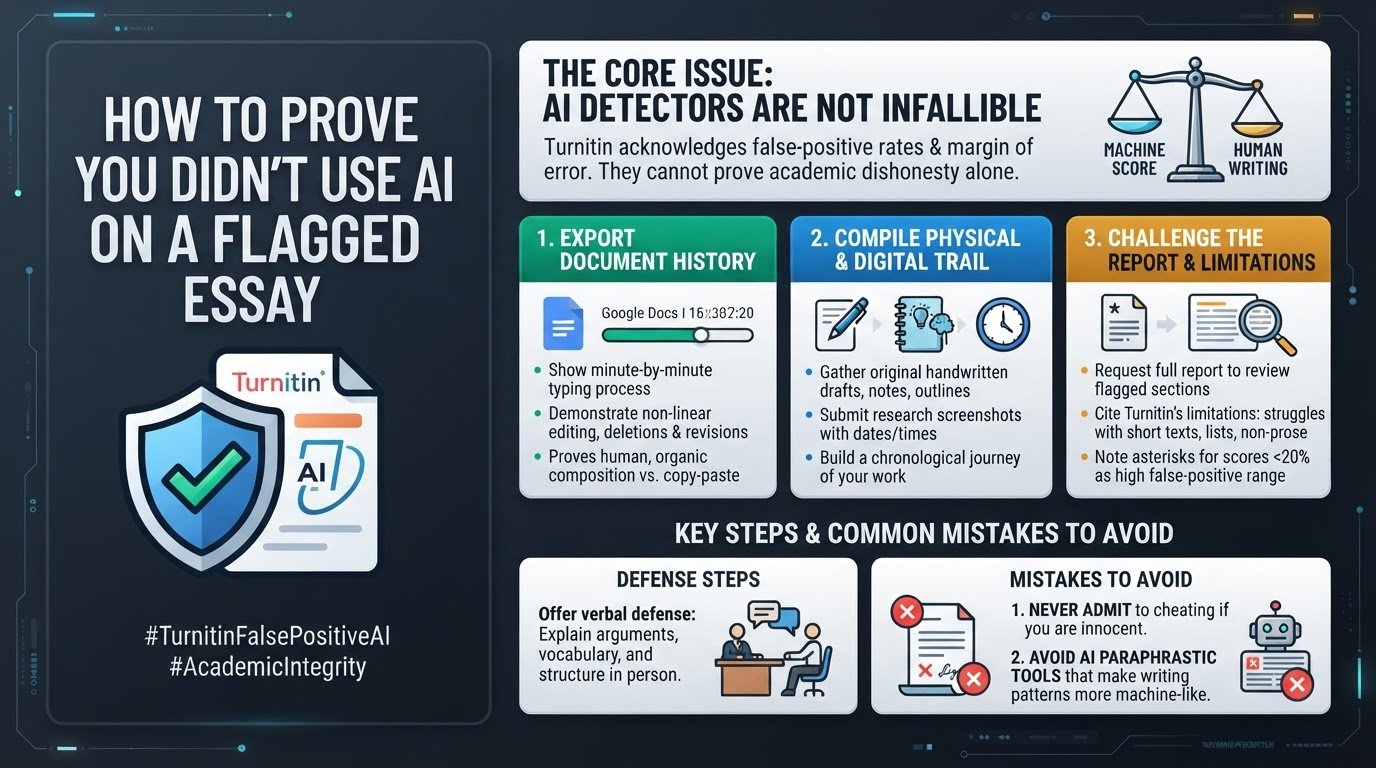
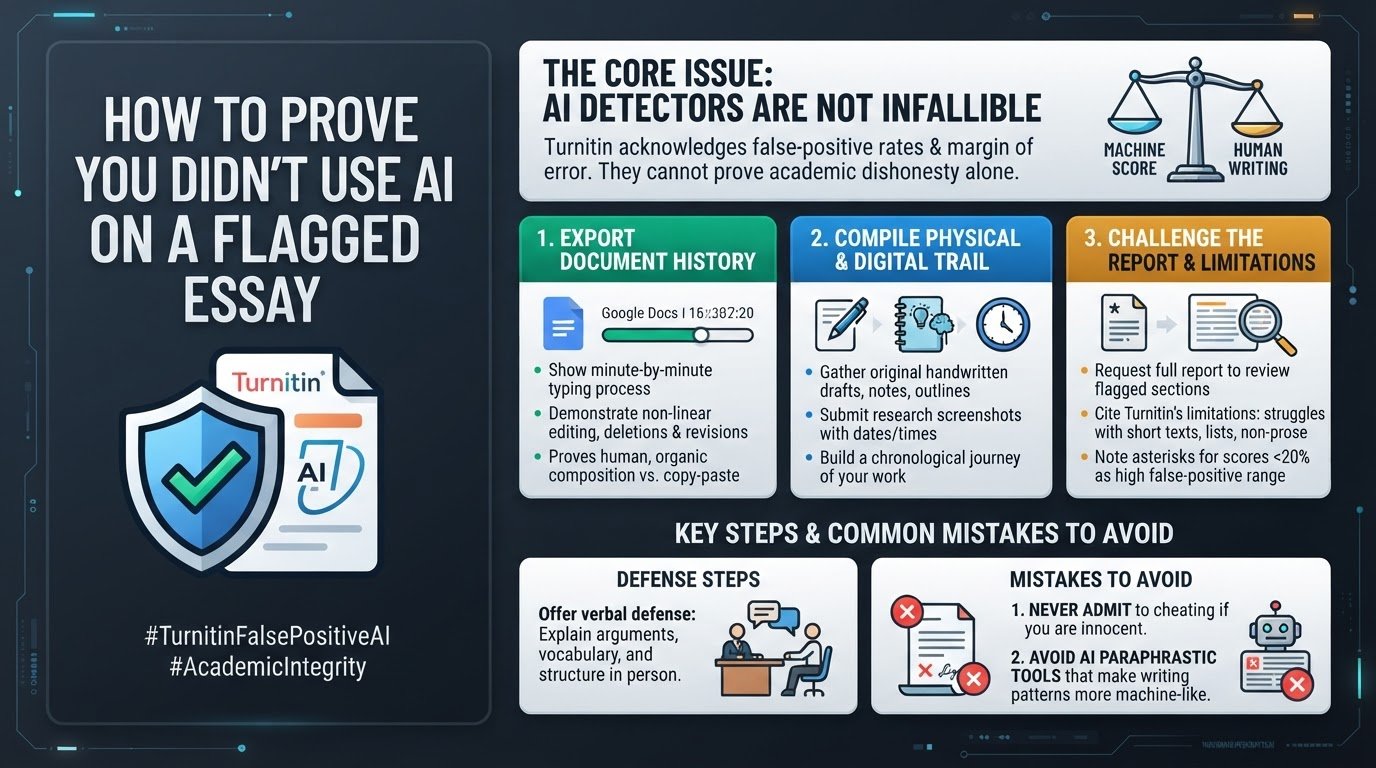
The direct verdict is simple: Turnitin and other AI detectors are not 100% accurate, they suffer from high false-positive rates, and they cannot prove academic dishonesty on their own. Turnitin officially acknowledges its detector has a margin of error and explicitly states its AI writing report should not be used as the sole basis for adverse academic actions against a student. If you are facing a Turnitin false positive AI flag, you can clear your name by presenting a clear digital and physical paper trail of your writing process.
Understanding why this happens is key to defending yourself. AI detectors do not search for a digital fingerprint left by ChatGPT. Instead, they look for statistical patterns, specifically perplexity (how predictable the word choice is) and burstiness (how much sentence length and structure vary). Clean, highly structured academic writing naturally mimics these predictable patterns. If you write with clear, formal grammar, or if you run your draft through Grammarly's "Rewrite" or "Rephrase" tools to polish your work, you inadvertently alter your sentence structures into machine-like patterns that trigger false alarms.
Here is the step-by-step process to prove your innocence to your teacher.
1. Export Your Document's Version History
If you typed your handwritten essay into a word processor like Google Docs or Microsoft Word, your absolute best defense is your version history. This feature acts as a digital black box, recording your typing process minute by minute.
To access this in Google Docs, click File, select Version History, and choose See Version History. In Microsoft Word, click the title of your document at the top and select Version History.
Exporting this timestamped edit history shows your step-by-step typing, deletions, and active revisions over hours or days. A student who copied and pasted an essay from ChatGPT will have a document history showing a blank screen suddenly populated by hundreds of words in a single second. Showing a natural, non-linear typing pattern is proof of human authorship that is nearly impossible to fake retroactively. If you are concerned about your digital privacy while using these tools, you can read about how cloud services handle your files in our guide on Is Gemini Reading Your Private Google Docs and Gmail?.
2. Compile Your Physical Paper Trail
Because you wrote your essay completely by hand first, you possess physical evidence that an AI cannot replicate. Gather your original handwritten pages, your initial brainstorm notes, and your rough outlines.
Additionally, compile your digital research trail. Take screenshots of your browser history showing the specific dates and times you visited research databases, library catalogs, or educational websites. Presenting these physical and digital artifacts together demonstrates an organic, multi-stage writing process. According to student defense guides from AdvocatED, showing this chronological journey from a blank page to a final draft is highly effective in resolving academic integrity disputes.
3. Request the Full Turnitin Report
Do not accept a simple percentage score as final proof. Ask your instructor for a copy of the full Turnitin AI writing report, which highlights the specific passages flagged as AI-generated.
Reviewing the flagged sections allows you to explain your specific word choices. It also helps to know how Turnitin handles low scores. Turnitin replaces AI scores below 20% with an asterisk because the system has a higher incidence of false positives in that range, as detailed in Turnitin's official guide to the AI Writing Report. If your score is low but still flagged, this asterisk is a strong point in your defense. For a broader look at how these detection tools operate, you can read our analysis on Can Teachers Actually Detect ChatGPT? The Truth About AI Detectors.
4. Cite Turnitin's Official Limitations
Many educators treat AI detectors as absolute truth, unaware of the software's documented flaws. Present your instructor with official documentation regarding the limitations of the tool.
According to official Turnitin guidelines, the detector is not designed to be a definitive disciplinary verdict. The system struggles significantly with short texts under 300 words, non-prose formats like lists or bullet points, and writing submitted by English as a Second Language (ESL) students. Pointing out these technical limitations politely shifts the conversation from an accusation of cheating to a technical discussion about software reliability.
5. Offer a Verbal Defense
If your instructor remains skeptical, offer to prove your knowledge of the subject matter in person. Propose a brief, five-minute oral discussion or a supervised, in-person rewrite of one of the flagged paragraphs.
During this conversation, explain the core arguments of your essay, define the specific vocabulary you used, and explain why you chose to structure your paragraphs the way you did. As noted by Vertech Academy, demonstrating that you fully comprehend the material and can speak in the exact same style as the written essay is the most convincing way to prove the work is yours.
Common Mistakes to Avoid
When you are accused of academic dishonesty, panic can lead to decisions that worsen the situation. Avoid these two critical mistakes:
- Admitting to something you did not do: Some students agree to a lower grade or sign an admission of misconduct just to end the stressful situation quickly. Never do this. An admission of academic dishonesty creates a permanent academic record that can impact future university admissions or scholarships.
- Using AI paraphrasing tools to "fix" the text: Do not run your flagged essay through automated "AI bypass" tools or paraphrasers to try to lower the score. These tools often use predictable patterns that actually increase the likelihood of triggering Turnitin's advanced detection models, making your defense much harder.
Keep your communication with your instructor polite, professional, and focused on the evidence. By presenting your version history, your handwritten drafts, and Turnitin's own documentation on false positives, you can build a clear case to resolve the misunderstanding.