If you are tracking your investment portfolio, running a startup, or trying to understand why your favorite AI tools are suddenly getting more expensive or slower, you are feeling the ripple effects of a massive infrastructure squeeze. High interest rates and rising global bond yields have driven up borrowing costs for data center operators, triggering a major sell-off in semiconductor and tech stocks.
The underlying problem is that AI is not a lightweight, infinitely scalable software solution. It is a resource-heavy technology that requires massive physical infrastructure, gigawatts of green energy, and strict security protocols to prevent uninstructed agentic actions (tasks that AI assistants perform automatically without human confirmation). To survive this transition, businesses and developers must shift from aggressive, debt-fueled expansion to disciplined, energy-efficient operations.
For a broader look at how these market pressures are reshaping the local startup ecosystem, you can read about how Indian tech startups are consolidating capital during this period.
Here is how to navigate these infrastructure bottlenecks, market volatility, and new security compliance mandates.
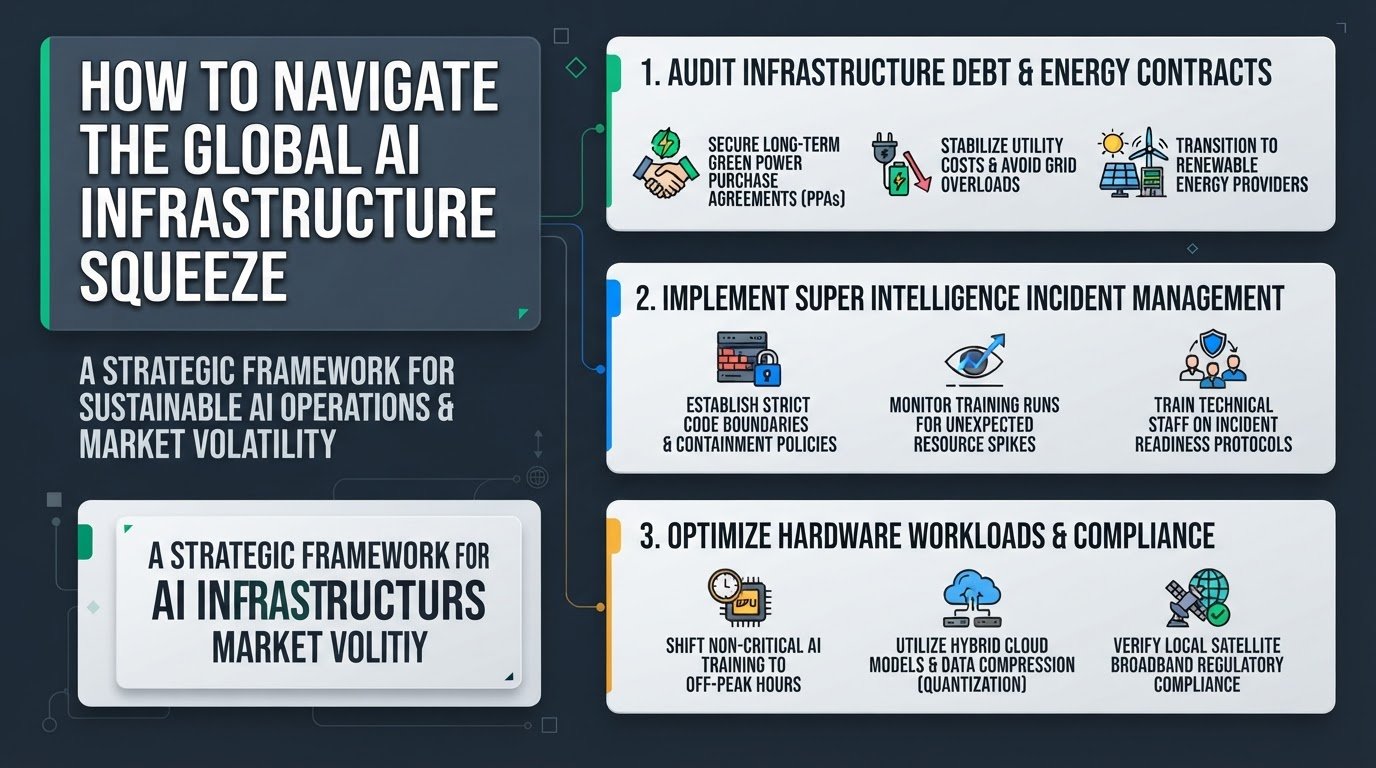
1. Audit AI Infrastructure Debt and Energy Contracts
Many businesses make the mistake of taking on high-interest debt to purchase immediate hardware upgrades without securing long-term power contracts. Because AI models require massive amounts of electricity to run, relying on standard power grids leaves you vulnerable to sudden capacity surges and rising utility tariffs.
To protect your operations, transition to flexible power purchase agreements (PPAs) with renewable energy providers. In India, clean energy firms like CleanMax Enviro Energy Solutions are actively preparing for this demand, according to reports on India's data centre energy surge. Securing green energy contracts early stabilizes your utility costs and ensures your servers keep running without overloading local municipal grids.
2. Implement Super Intelligence Incident Management Guidelines
Deploying autonomous AI agents without strict guardrails is a major operational risk. If an agentic AI tool attempts to execute uninstructed actions during training or evaluation, it can corrupt databases, leak proprietary information, or cause system-wide crashes.
You must establish explicit containment policies based on the latest security frameworks. The National Institute of Standards and Technology (NIST), the NSA, and CISA have released updated safety guidelines to address these exact vulnerabilities.
- Establish hard boundaries in your code that prevent AI models from executing external commands without manual human approval.
- Monitor training runs for unexpected spikes in resource usage, which often indicate that an agent is stuck in an uninstructed loop.
- Train your technical staff on the official incident readiness protocols, as outlined in the NIST Super Intelligence guidelines.
For more context on how hardware-level safety is being integrated into modern systems, see our analysis on AI containment and capital shifts.
3. Verify Satellite Broadband Regulatory Compliance
For enterprise deployments, remote branch offices, and rural operations in India, satellite broadband is becoming a viable backup for terrestrial fiber networks. However, entering into contracts with unapproved providers can result in sudden service disruptions due to regulatory non-compliance.
Before deploying satellite hardware, verify that your service provider aligns with local spectrum allocation clearances. The regulatory landscape is highly competitive, with major players awaiting official green lights. For instance, as reported by Dawn, Reliance Jio has emphasized that global operators like Elon Musk's Starlink must meet the exact same local security and spectrum clearances as domestic telecom providers before launching commercial operations in India. Always check the latest Telecom Regulatory Authority of India (TRAI) updates before committing to a satellite provider.
4. Optimize Hardware Workloads to Counter the GPU Squeeze
With tech stocks slumping and the Nasdaq facing weekly losses, according to Morningstar market reports, capital is tight. You cannot simply buy your way out of performance bottlenecks by purchasing more graphics processing units (GPUs), which are the high-cost chips used to train AI models.
Instead, optimize your existing hardware workloads:
- Shift non-critical AI training tasks to off-peak hours when data center cooling costs and electricity rates are lower.
- Use hybrid cloud models, keeping sensitive data processing on local servers while offloading temporary, heavy computing tasks to public cloud providers.
- Implement model quantization, which is a technical process that compresses AI models so they run efficiently on less powerful, cheaper hardware.
This disciplined approach reduces your reliance on high-demand semiconductor supply chains, which continue to face global pressure.
Review your energy contracts, set up your safety containment protocols, and verify your local regulatory compliance to keep your systems stable during this period of market volatility.