Your social media feeds and news outlets are flooded with headlines about the latest Indian artificial intelligence startup raising millions of dollars, alongside hyper-realistic videos of tech founders announcing revolutionary breakthroughs. It is increasingly difficult to separate genuine technological innovation from marketing hype, clever API wrappers, and synthetic media deepfakes.
The bottom line is that India's AI and tech startup ecosystem is not experiencing an across-the-board funding explosion. While headlines suggest an easy gold rush, venture capital funding has actually remained flat, stagnating around the 10 billion to 10.9 billion USD mark, according to Business Standard. Investors are heavily consolidating their capital, funneling massive sums into a select few deeptech and generative AI companies while smaller players struggle, a trend analyzed in depth in our report on how India Tech Pulse: Late-Stage Funding Surges Amid AI Boom.
To navigate this landscape without falling for inflated metrics or synthetic media, you need a practical verification strategy. Here is how to verify startup claims, detect synthetic media, and identify genuine technological developments.
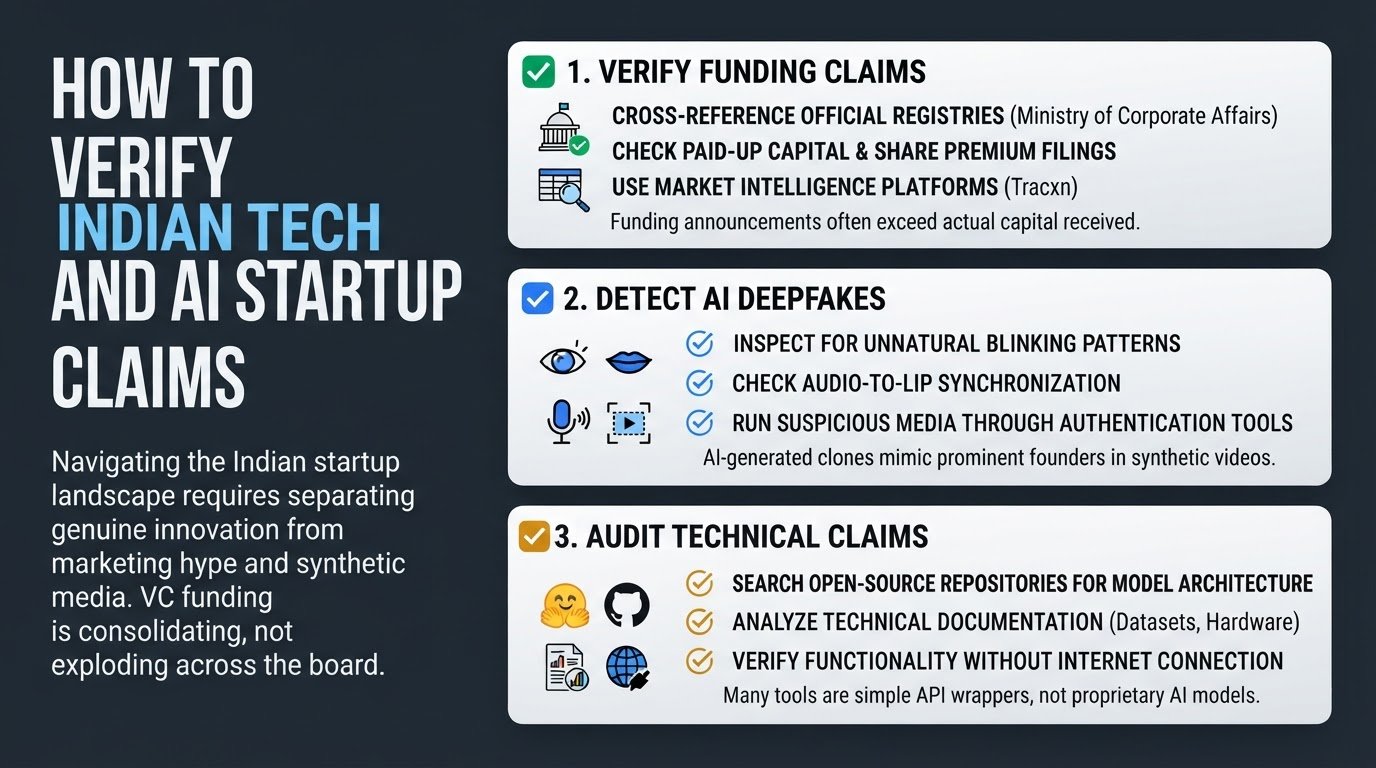
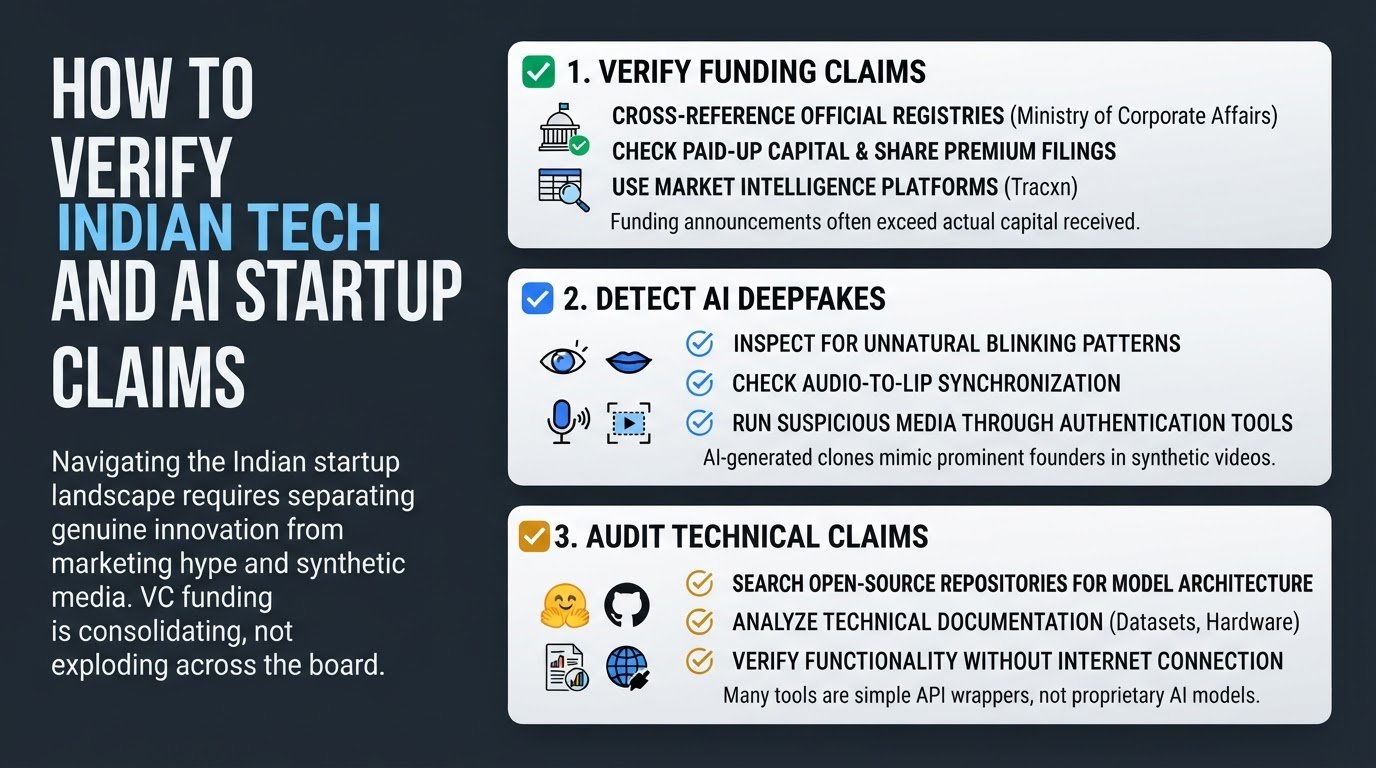
1. Cross-Reference Funding Claims with Official Registries
Do not rely on press releases or social media announcements to verify a startup's valuation or funding status. Companies often announce "intended" funding or include soft commitments that have not actually closed.
- Visit the official Ministry of Corporate Affairs portal in India to search for the company's registered name.
- Check the company's actual paid-up capital and share premium filings. This public registry shows the exact amount of capital that has legally entered the company's bank accounts.
- Use verified market intelligence platforms like Tracxn to cross-reference cap tables and historical funding rounds. If a startup claims a massive valuation but has only filed basic seed-level paid-up capital, the announcement is likely premature or exaggerated.
2. Spot and Verify Deepfake Media of Tech Leaders
The rise of synthetic media and deepfakes, heavily discussed at the India Mobile Congress, means you can no longer trust video announcements or audio clips of tech executives at face value. Scammers and hype-builders frequently use AI-generated clones to mimic prominent founders.
- Inspect the video closely for unnatural blinking patterns. Deepfake algorithms often struggle to replicate natural eye movement and blink rates.
- Look for mismatched audio-to-lip synchronization. Pay attention to the edges of the mouth and the jawline, where synthetic overlays often blur or glitch during rapid speech.
- Run suspicious media through specialized detection tools. Platforms like the Microsoft Video Authenticator or Intel FakeCatcher analyze pixel color changes and subtle grayscale variations that are invisible to the human eye.
3. Audit AI Claims Against Open-Source Repositories
Many startups claim to have built proprietary foundational AI models. In reality, a large percentage of these tools are simple API wrappers, which are basic software interfaces that route user queries to existing models like OpenAI's GPT-4 or Meta's Llama without any unique underlying technology.
- Search for the startup's model architecture on open-source repositories like Hugging Face or GitHub. Genuine AI developers publish their model weights, training parameters, and performance benchmarks for peer review.
- Analyze the startup's technical documentation. If they do not disclose their training dataset, hardware infrastructure, or evaluation metrics, they are likely running on third-party APIs.
- Check how the tool handles offline tasks. If the software completely fails to function without an active internet connection to external servers, it is highly likely to be a repackaged service rather than a local, proprietary model.
4. Confirm Government-Backed Space and Deeptech Approvals
With India launching major public-private partnerships, many startups claim to be official partners of national space and defense programs. You can verify these claims directly through official channels.
- Track official approvals and authorizations directly through the Indian National Space Promotion and Authorization Center portal. Genuine space tech startups must be registered and approved by this body to operate.
- Verify if the startup is part of official government incubation pipelines, such as the ASPIRE platform launched at the India Mobile Congress, which connects deeptech prototypes with telecom innovators. You can read more about these initiatives in our coverage of IMC 2026: ASPIRE to Launch Indian DeepTech Startups.
- Cross-reference claims of public funding with official announcements regarding the national deeptech pool, which remains a key driver for genuine hardware and aerospace innovation, as detailed in our guide on the India Prepares Massive $25B Deep Tech Funding Pool. Startups powering India's space tech boom must have verifiable regulatory clearance, according to Forbes.
Common Verification Mistakes to Avoid
- Relying on social media hype: Avoid treating viral posts on LinkedIn or X as financial or technical proof. Always wait for regulatory filings or official institutional press releases.
- Assuming all AI tools are unique: Do not assume a tool is revolutionary just because it has an Indian name or local branding. Check the underlying API dependencies before investing time or capital.
- Ignoring the funding concentration reality: Understand that while a few high-profile AI startups are preparing for massive public listings, according to Rediff, this does not mean the average early-stage startup has easy access to capital. Keep your expectations grounded when evaluating new market entrants.