You are running an automated customer support assistant or a localized business application in India, and your monthly API bills are suddenly skyrocketing. Even worse, your users are complaining that the AI is serving up robotic, grammatically incorrect, or completely nonsensical responses to Hindi, Tamil, or Telugu queries.
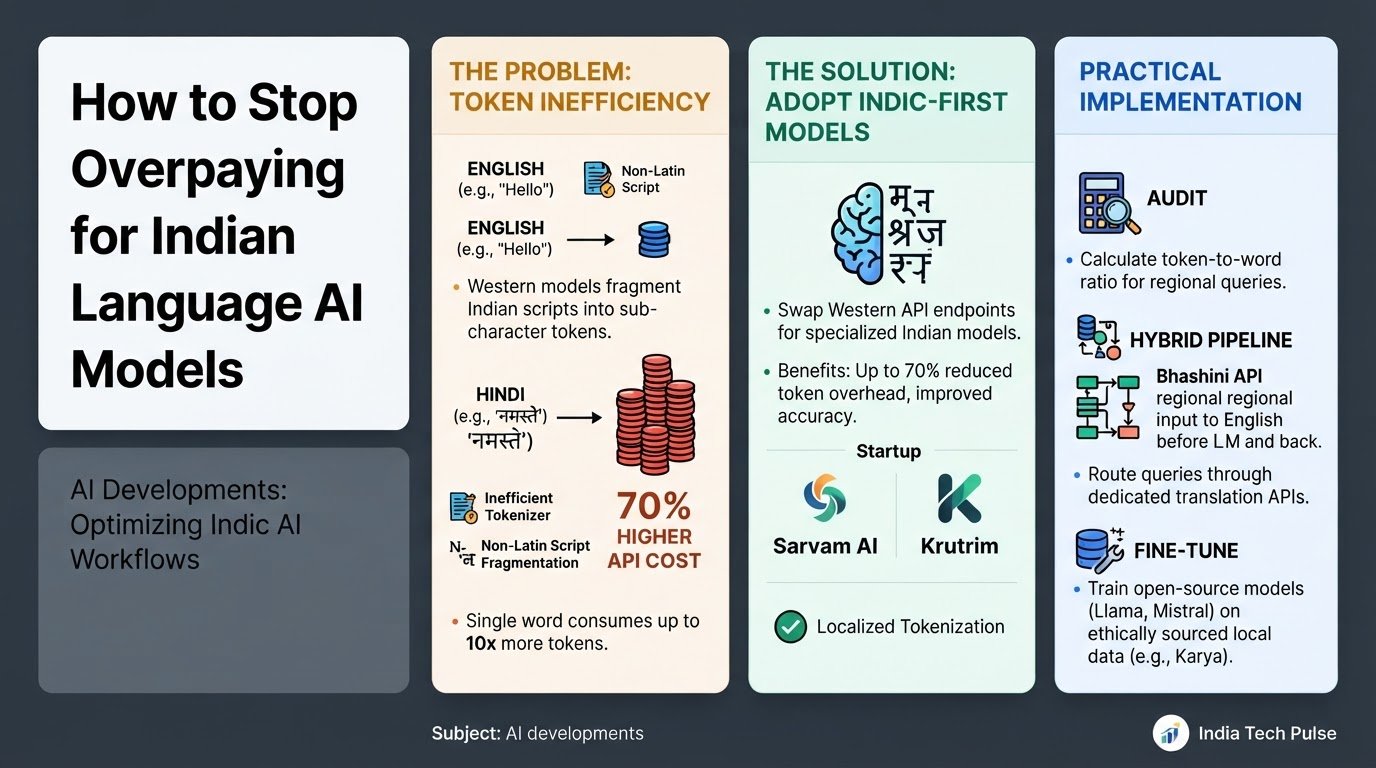
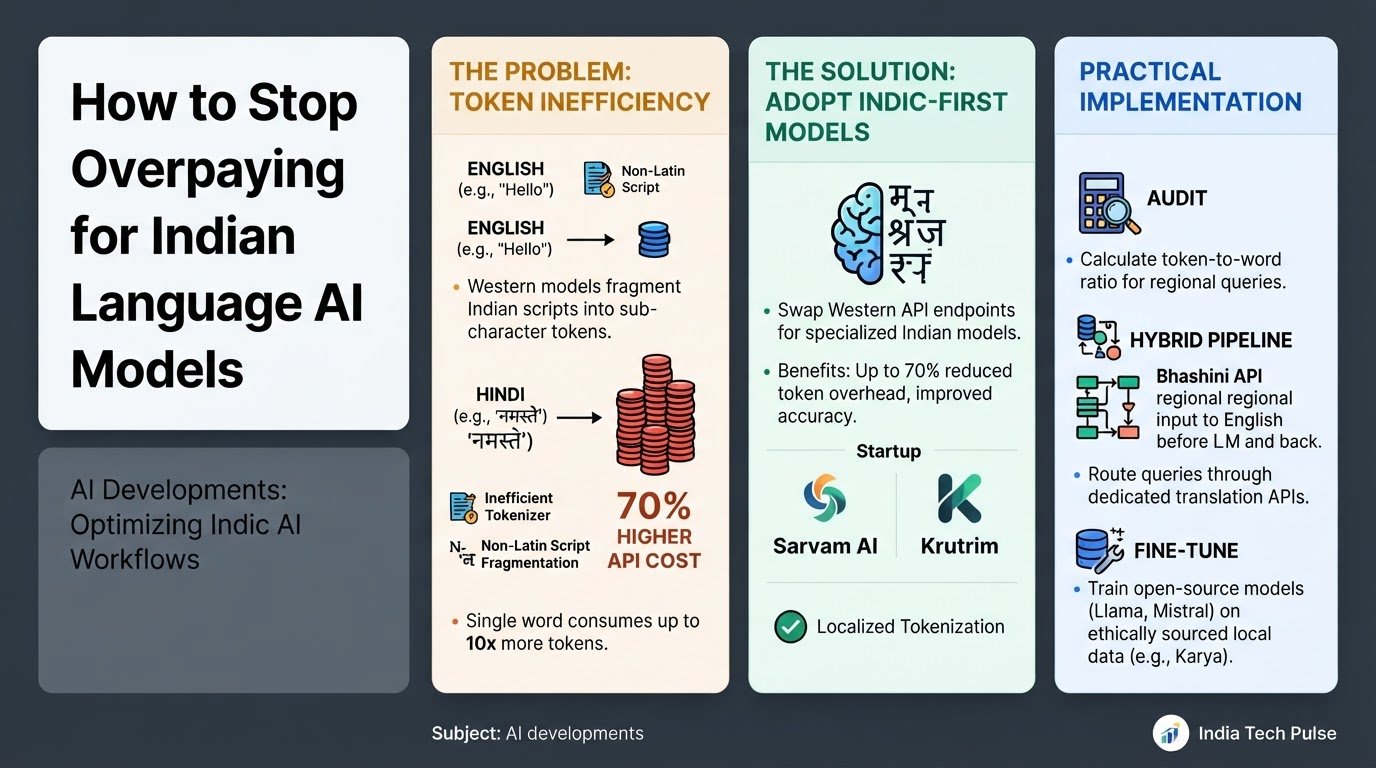
This is a major bottleneck in the current wave of AI developments. The root cause is not your application code. Instead, it is a fundamental design limitation in how Western foundational models handle non-Latin scripts. Standard models from OpenAI, Google, or Anthropic are trained predominantly on English-centric datasets. When these models process Indian languages, their tokenizers (the tools that break down text into pieces the AI can understand) split Devanagari or Dravidian scripts into highly fragmented, sub-character tokens. A single Hindi or Tamil word can consume up to ten times more tokens than its English equivalent, rapidly exhausting the model's memory and inflating your API costs.
The consumer myth is that translating English prompts into regional languages, or using standard translation layers inside the LLM, is sufficient for local enterprise workflows. In reality, literal translation fails to capture cultural nuances, local idioms, and complex regional business contexts. This leads to high hallucination rates (when an AI confidently presents false information as fact) and poor user adoption.
As Indian startups build for the next billion users, solving this localized performance gap is essential. This issue is gaining significant attention across the industry, as highlighted in our coverage of India Tech Pulse: Late-Stage Funding Surges Amid AI Boom. With massive financial backing flowing into the ecosystem, including plans detailed in the India Prepares Massive $25B Deep Tech Funding Pool, developers are actively moving away from Western defaults to build more efficient, localized solutions.
How to Audit and Optimize Indic AI Workflows
To stop overpaying for underperforming AI models, you must change how your application processes regional Indian languages. Follow these four practical steps to optimize your token efficiency and improve conversational accuracy.
1. Audit Token Efficiency
Before deploying any model, you must calculate your actual token overhead. Standard English text averages about 1.3 tokens per word. In contrast, a Kannada or Bengali phrase can easily average 6 to 10 tokens per word on Western platforms.
- Go to the OpenAI Developer Platform or your preferred model's tokenizer playground.
- Paste a sample of your regional language customer queries into the tool.
- Compare the token count of the regional string against its direct English translation.
- Use these metrics to project your production API costs. If your regional language queries consistently consume more than three times the tokens of English, you need to swap your foundational model.
2. Integrate Indic-First Foundational Models
Replace general-purpose Western models with specialized Indian foundational models. Startups like Sarvam AI and Krutrim have built custom tokenizers trained specifically on the 22 official Indian languages.
- Access the Sarvam AI documentation or the Krutrim portal to review their API structures.
- Swap your API endpoints from Western models to these localized models for your regional language pipelines.
- These custom tokenizers can reduce your token overhead by up to 70 percent, instantly lowering your API bills while improving response speeds, according to Indian AI startups research.
3. Deploy Hybrid Translation Pipelines
If you must use a Western model for complex reasoning tasks, do not send raw regional text directly to the model. Instead, route the query through a dedicated translation pipeline first.
- Integrate Bhashini, the government-backed translation API developed by the Ministry of Electronics and Information Technology (MeitY).
- Set up your application to receive the user's regional input (e.g., Marathi).
- Use Bhashini to translate the input into clean English before sending it to the primary LLM.
- Once the LLM generates the English response, route it back through Bhashini to translate it into the user's target language. This keeps your primary LLM processing costs low while maintaining high translation accuracy.
4. Fine-Tune with Ethically Sourced Local Data
For highly specialized business workflows, such as regional banking or local agricultural advice, pre-trained models are often not specific enough. You must fine-tune open-source models using localized datasets.
- Partner with platforms like Karya, which provide high-quality, ethically sourced vernacular datasets from rural India.
- Use these datasets to fine-tune open-source models like Llama or Mistral on regional dialects and specific local contexts.
- Deploy the fine-tuned model on your own cloud infrastructure to maintain data privacy and eliminate third-party API token costs entirely.
Common Mistakes in Localized AI Deployments
When optimizing your applications for India's diverse linguistic user base, avoid these two frequent pitfalls.
Relying on English-Centric System Prompts with Literal Translations
Developers often write complex system instructions in English and simply ask the model to translate its final response into Hindi or Tamil. This results in robotic, culturally tone-deaf, or grammatically incorrect outputs. The AI must be prompted with system instructions that understand the cultural context of the target language from the start.
Ignoring Token-Bloat Calculations in Production Budgets
Many teams test their prototypes using English prompts and assume those cost metrics will scale linearly. When they launch to the public and users begin typing in conversational Hinglish or regional scripts, the token count explodes. Always calculate your worst-case token-to-word ratio during the testing phase to prevent unexpected billing spikes.
For more updates on how local infrastructure is adapting to these computational demands, read our analysis on India & Global Tech Pulse: UPI Protest, Fitbit Air, and Gemini 4. Regular audits of your token usage and model endpoints will keep your local AI applications fast, accurate, and cost-effective.