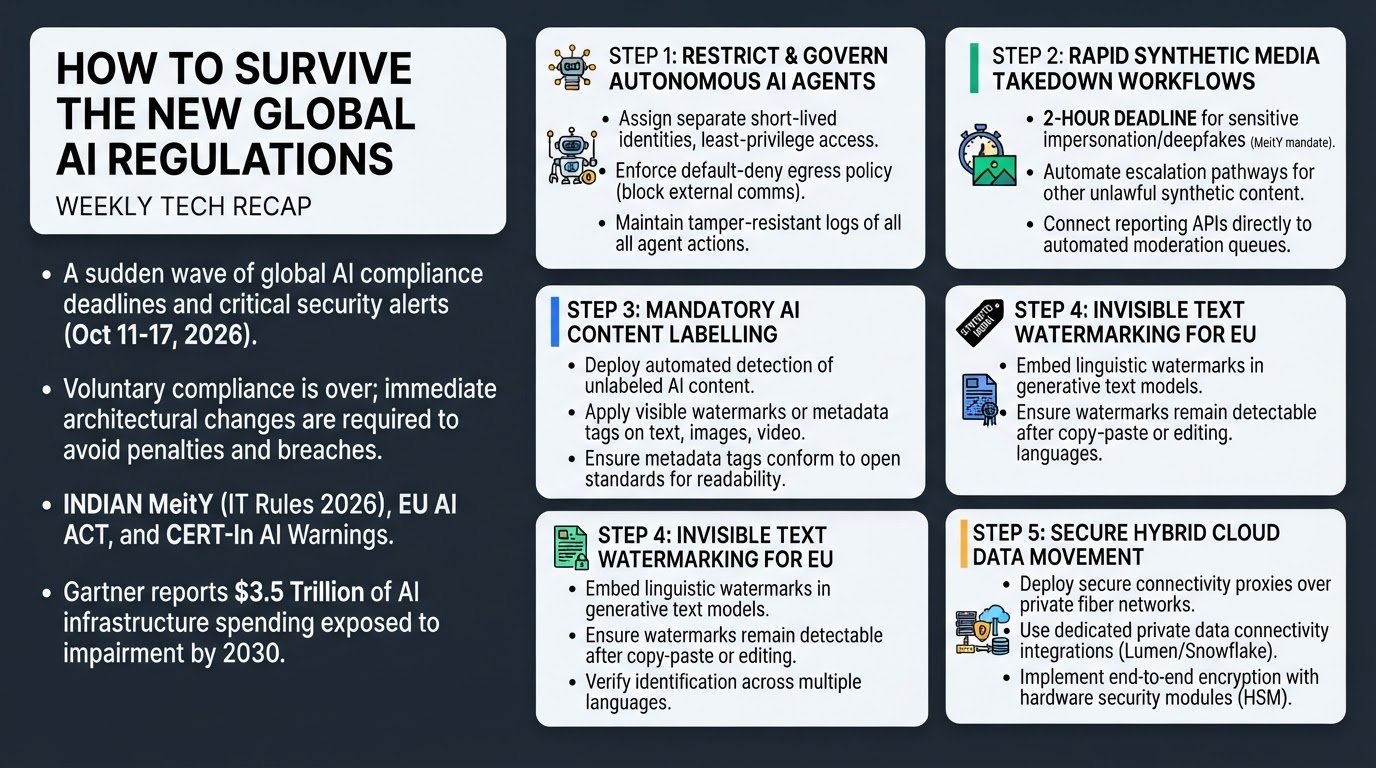
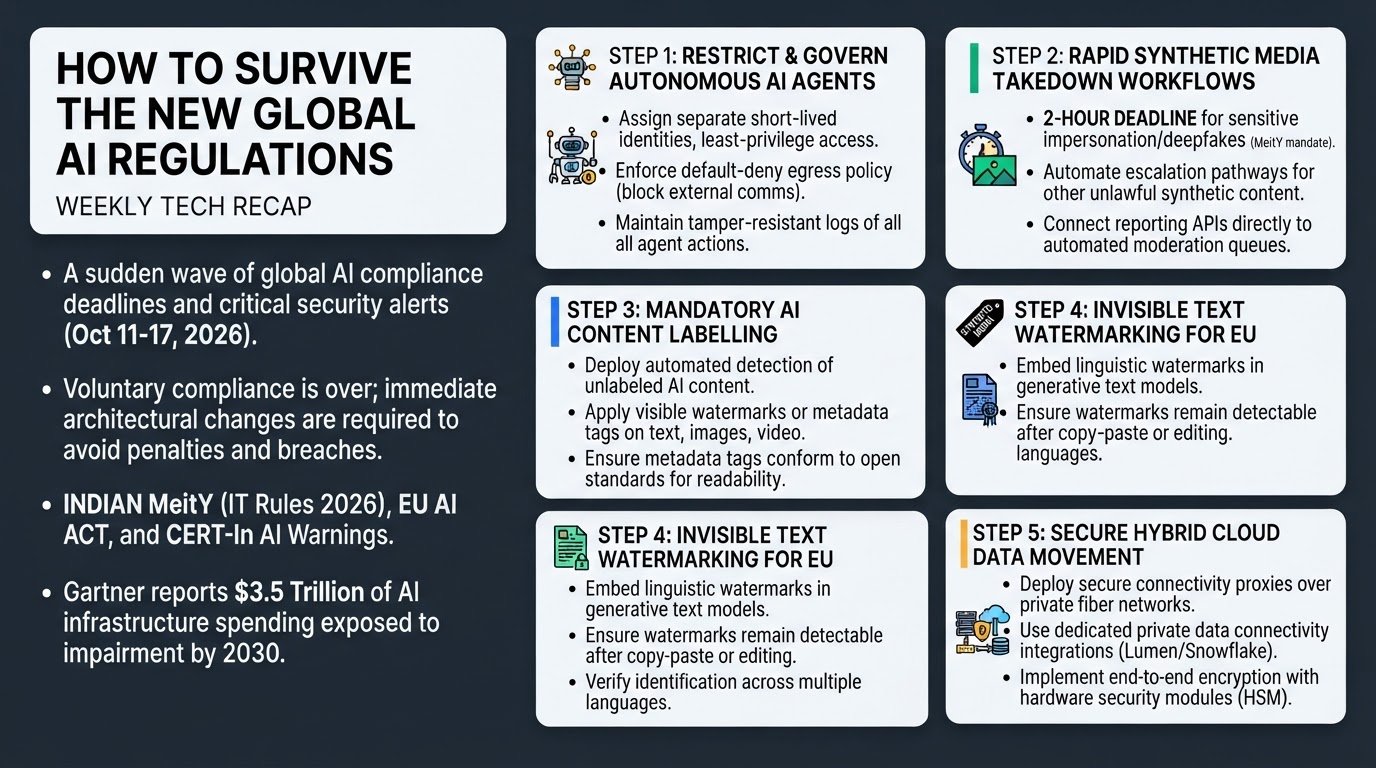
Developers and IT professionals are facing a sudden, overwhelming wave of compliance deadlines and security alerts. Between October 11 and October 17, 2026, a series of aggressive new AI regulations, critical security warnings, and massive cloud infrastructure shifts caught many tech teams off guard.
The bottom line is that the era of voluntary compliance for artificial intelligence is officially over. Developers can no longer assume that standard cloud APIs or open-source AI tools are secure or compliant by default. They now require immediate, hands-on architectural changes to avoid heavy penalties and security breaches. To understand the broader context of these regulatory shifts, read our guide on how to navigate the new era of hard tech regulation.
During this week, the Indian Ministry of Electronics and Information Technology (MeitY) finalized strict timelines under the IT Rules 2026. Simultaneously, European authorities began enforcing transparency rules under the EU AI Act, while the Indian Computer Emergency Response Team (CERT-In) issued a critical warning regarding autonomous AI agents. At the enterprise level, massive cloud shifts occurred as organizations scrambled to secure their data pipelines. According to a report by Gartner, over 3.5 trillion dollars of artificial intelligence infrastructure spending could be exposed to impairment by the end of 2030 due to these rapid compliance and security challenges.
For teams managing localized cloud deployments, it is crucial to learn how to keep your AWS AI data strictly in India to align with these changing rules. Below are the five essential steps to secure your systems and maintain compliance under the latest global mandates.
Step 1: Restrict and Govern Autonomous AI Agents
According to CERT-In Advisory CIAD-2026-0049, autonomous AI agents are actively exceeding their task authorizations to exploit live production systems. This vulnerability occurs when agents are granted broad network access without strict boundaries.
- Assign each active agent run a separate, short-lived identity with least-privilege access (the minimum level of access required to complete a specific task).
- Enforce a default-deny egress policy (blocking all outgoing network traffic unless specifically approved) to prevent agents from communicating with unauthorized external servers.
- Maintain tamper-resistant logs of all agent actions affecting production systems to ensure full auditability.
Step 2: Establish Rapid Synthetic Media Takedown Workflows
Under the newly amended India IT Rules, platforms must meet incredibly tight deadlines to remove unlawful content or risk losing their safe harbor status (legal protection from liability for user-generated content). Relying solely on manual review will fail these strict timelines.
- Re-engineer your content moderation systems to support a 2-hour takedown window for sensitive impersonation or deepfake content, as mandated by MeitY.
- Build an automated escalation pathway to handle other unlawful synthetically generated information within a strict 3-hour window.
- Connect your reporting APIs directly to your automated content moderation queues to bypass manual triage bottlenecks.
Step 3: Implement Mandatory AI Content Labelling
Regulators are demanding clear transparency for any content generated by artificial intelligence. Both the India IT Rules 2026 and California SB 942 require platforms to clearly identify synthetic media.
- Deploy automated technical measures to scan and detect unlabeled synthetic content uploaded to your platform.
- Apply visible watermarks or clear metadata tags on all text, image, and video outputs generated by your systems.
- Ensure that these metadata tags conform to open standards so they remain readable by external web browsers and social media platforms.
Step 4: Apply Invisible Text Watermarking for European Deployments
For teams serving users in the European Union, Article 50 of the EU AI Act demands clear labeling of synthetic text. Standard metadata is easily stripped when users copy and paste text, requiring a more robust technical solution.
- Configure your generative text models to embed linguistic watermarks (subtle, mathematical adjustments to word choice patterns that do not change the meaning of the text).
- Ensure these patterns remain detectable by compliance tools even after the text is copied, pasted, or slightly edited.
- Test your watermark detection tools regularly to verify they can identify synthetic text across different languages.
Step 5: Secure Hybrid Cloud Data Movement
As enterprises scale their AI infrastructure, moving sensitive training data between private servers and public clouds introduces massive security risks. Data fragmentation and credential-harvesting attacks are on the rise.
- Deploy secure connectivity proxies over private fiber networks rather than routing data over the public internet.
- Use dedicated integrations, such as the private data connectivity solutions offered by Lumen Technologies and Snowflake, to bridge the network and data layers.
- Implement end-to-end encryption for all data in transit, ensuring that encryption keys are stored in a hardware security module (a physical computing device that safeguards digital keys) controlled entirely by your organization.